

The Problem with Positional Ambition
AOC just said something that every stressed-out high school senior needs to hear.
Alexandria Ocasio-Cortez’s chummy Chicago confab with David Axelrod grabbed a few predictable headlines last week. Most orbited her answer to a question about running for President. (AOC Drops BIGGEST HINT Yet About Next Presidential Race, Leaves Trump Camp STUNNED boomed one.)
But tucked into AOC’s parse-worthy response was something much more praiseworthy: a piece of life advice that every stressed-out high school senior – and every Orienteer Kid – needs to hear. You need not want her anywhere near the White House to see its value.
Let’s set the scene: AOC spoke to students at University of Chicago’s Institute of Politics, which Axelrod leads. Like their high-achieving compatriots at U.S. News-approved colleges around the country, many in the lecture hall have been amped up on success steroids since their mothers’ amniotic fluid vibrated Mozart. These Gen Z stand-outs were her audience. Not the chattering politicos, odds-making Polymarketeers, or click-baiting headline writers who missed her message.
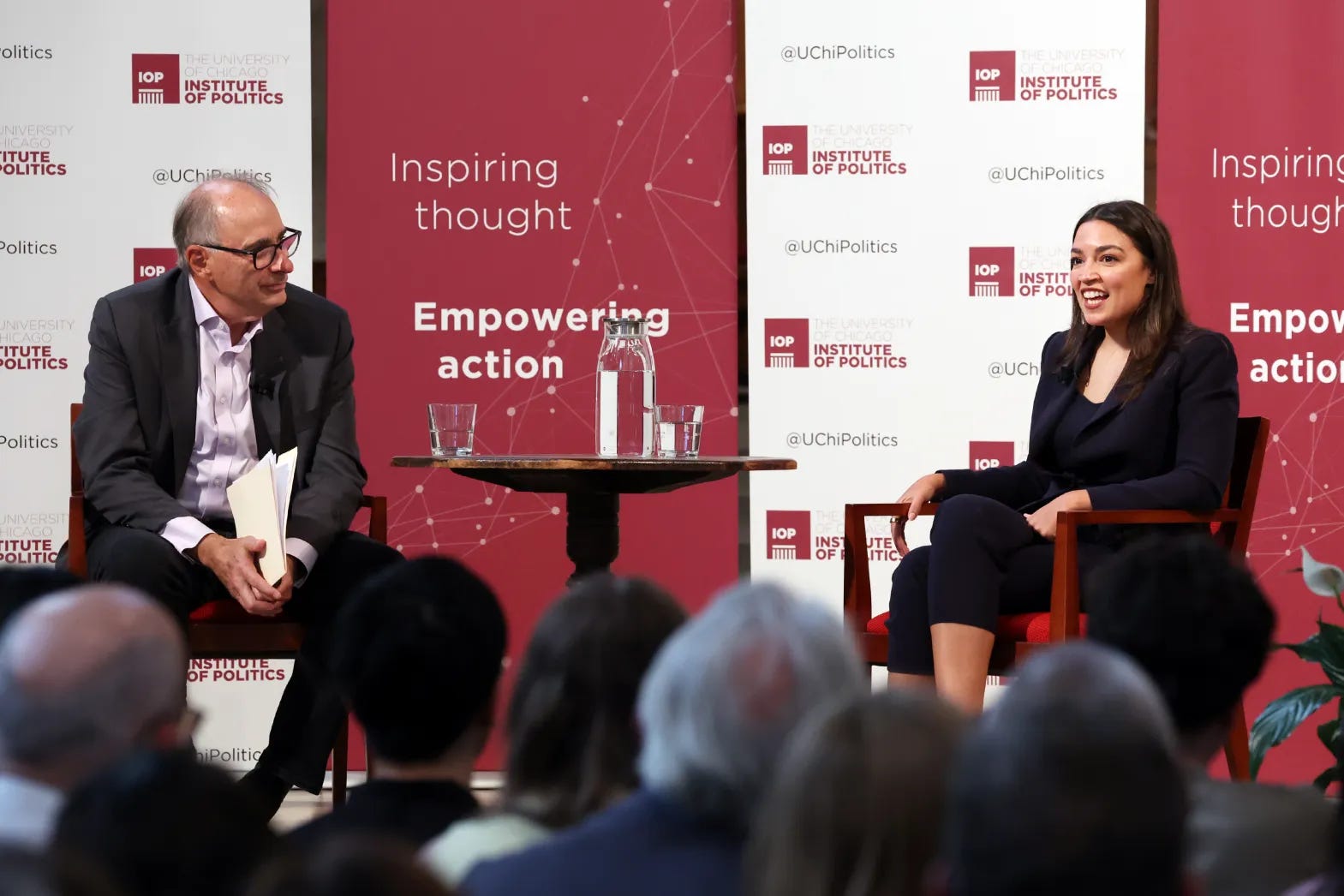
Axelrod prompted the moment this way (I’ve edited these excerpts slightly for brevity):
Axelrod: I would be drawn and quartered if I did not say this: There are a lot of people who would like you to run for President in 2028.
AOC responds by unloading on those who think her aspirations are too big for their britches: “the modern-day barons who own the [Washington] Post and own the algorithms.”
AOC: What’s funny about that is that they assume that my ambition is positional. They assume that my ambition is a title or a seat.
What’s funny about that line is that the young aspirants in the room are chockablock with “positional ambition.” Those of us who are older have peppered them with it: the idea that the title – AP Scholar, Student Body President, Harvard graduate, Law Firm Partner – is the goal. We’ve told them since childhood to chase accolades, awards, and acceptances. Even as they point their moral compasses more boldly than previous generations, many of them still believe that getting flowers from authority is the sine qua non.
You can almost feel the bout of cognitive dissonance coming on: What’s wrong with wanting a title? She responds simply:
AOC: My ambition is to change this country.
If you are a millennial or older, or focused on her 2028 plans, there’s your sound bite: looks like she wants to run for President. But read (or listen) a bit closer and you’ll see that she isn’t saying that at all: in fact, she is saying the exact opposite thing. “My ambition is to change this country” means that being President is not important to her. It isn’t the goal. What’s important - the pursuit with meaning - is creating change.
She goes further:
AOC: Presidents come and go. Senate, House seats, elected officials come and go. But single payer healthcare is forever. A living wage is forever. Workers’ rights are forever. Women’s rights…
When you aren’t attached – when you haven’t been fantasizing about being this or that since you were seven years old – it is tremendously liberating. I get to wake up every day and say, “How am I going to meet the moment?” I make my response less to an attachment to some title or position and working backwards from there. I make my decisions by waking up in the morning and saying, “What move or decision can I make today that’s going to get us closer to that future?”
You don’t have to be a liberal or like the “Tax the Rich” dress to take her underlying message to heart: focusing on titles won’t make your life worthwhile. Instead, ask yourself what you can do next to have the biggest impact on the problems you care about most.
The point transcends ideology. In fact, Charlie Kirk – who repeatedly denied interest in running for President, despite similar swooning from supporters – expressed a nearly identical point in a 2022 conversation with an Atlantic reporter, who wrote:
“Look, here’s the thing,” Kirk told me. “We’re here to win.” He meant more than the upcoming midterms or the next presidential election. “Politics, it’s fine,” he told me. “It’s just that politics is moments in time.” Kirk wanted to refashion America itself[.]
Kirk wasn’t about the office, either. Like him or not, he measured his success in change.
What would happen if the best and brightest kids in our nation – Democrats, Republicans, and otherwise – stopped focusing on titles and started asking what change they wanted to make in our world? What if we helped them decouple the ability to make change from the ability to get into an elite college? What if the thing that would really make us parents proud were the change our kids create, not the colleges where they matriculate?
I hear the counterargument from my students (and many of their parents) all the time: if you want to make change, you need the title and the prestige first. A good college gives you the best options. Don’t eight of nine Supreme Court justices have Ivy League degrees?
I get it: positional ambition is seductive. It is a siren’s call of job security, a soothing back-pat in a back-stabbing world. AOC (who went to Boston University) and Kirk (who dropped out of community college) are both asking young people to pursue a less certain, more meaningful path. And they are right, even if you don’t like their politics.
If you believe prestige is a prerequisite for meaning, you may soon make it a substitute for meaning, too. If your vision for changing the world requires first being anointed by the status quo, you are disqualifying yourself before you even begin.
Martin Luther King, Jr. says this: “Be ashamed to die until you have achieved some victory for humanity.” Titles and seats and college acceptances are not victories for humanity.
Whether they learn it from MLK, AOC, Charlie Kirk, or another source, I want this amazing generation to know that a life well-lived is not about the trophies we accumulate. It is about whether each of us leaves our world better: more just, more humane, and more hopeful.
Thank you for reading, Maya!
Absolutely. It’s taken me years to be ok with this, but I think the sooner we all learn this and teach this - especially to kids - the happier and more fulfilled we all will be. Thanks for highlighting this.